F-14 Tomcat B/N: 164346
The Grumman F-14 Tomcat is an American supersonic, twin-engine, two-seat, twin-tail, variable-sweep wing fighter aircraft. The Tomcat was developed for the United States Navy’s Naval Fighter Experimental (VFX) program after the collapse of the F-111B project. The F-14 was the first of the American teen-series fighters, which were designed incorporating air combat experience against MiG fighters during the Vietnam War. The F-14 first flew in December 1970 and made its first deployment in 1974 with the U.S. Navy aboard USS Enterprise (CVN-65), replacing the McDonnell Douglas F-4 Phantom II. The F-14 served as the U.S. Navy’s primary maritime air superiority fighter, fleet defense interceptor, and tactical aerial reconnaissance platform into the 1990s. The Low Altitude Navigation and Targeting Infrared for Night (LANTIRN) pod system were added in the 1990s and the Tomcat began performing precision ground-attack missions. The Tomcat was retired from the U.S. Navy’s active fleet on 22 September 2006, having been supplanted by the Boeing F/A-18E/F Super Hornet. The F-14 remains in service with the Iranian Air Force, having been exported to Iran in 1976.

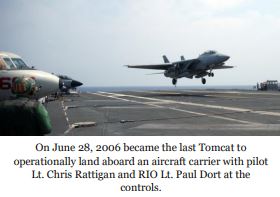
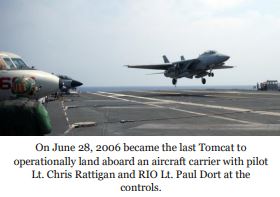
The museum’s F-14 “Sweet Little Miss” was delivered to the US Navy in February 1992 and went on to participate in Operation Iraqi Freedom serving aboard USS Abraham Lincoln and USS Theodore Roosevelt. “Sweet Little Miss” was aboard the USS Abraham Lincoln during President Bushes “Mission Accomplished speech. On June 28, 2006 became the last Tomcat to operationally land aboard an aircraft carrier with pilot Lt. Chris Rattigan and RIO Lt. Paul Dort at the controls.
Specifications
- Manufacturer
- Grumman
- Empty Weight
- 43735 pounds
- Maximum Takeoff Weight
- 74350 pounds
- Length
- 62 feet 9 inches
- Height
- 16 feet
- Spread Wingspan
- 64 feet 0 inches
- Swept Wingspan
- 38 feet 0 inches
- Engine
- 2 General Electric F110-GE-400 afterburning turbofans
- Maximum Speed
- Mach 2.34
- Combat Radius
- 500 nautical miles